Operation Sindoor: A Comprehensive Analysis of India's Decisive Military Campaign Against Pakistan (May 7–10, 2025)
A detailed report on the India–Pakistan conflict of May 2025, covering the military equipment deployed by both sides, the operational strategy behind India's 88-hour campaign, and geolocated satellite imagery with coordinates for every confirmed strike site — from terrorist camps and airbases to radar installations across Pakistan and PoK.
Coverage Lens
Conflict / Diplomacy
Brief Sections
12
Crossrefs
00 events
Briefing Snapshot
Lead
Admin Analyst
Country Focus
Regional watch
Update Tempo
Live desk cross-reference
On This Brief
Intelligence Brief
Structured situational analysis designed for rapid read-through and deeper section jumps.
Want to read this offline?
Full article with satellite imagery as a 4.7 MB PDF
Authors: Conflict.asia Management · Research refined with AI assistance · Published March 2026
Editor's Note
This analysis draws on multiple open-source intelligence reports, independent European military assessments, satellite imagery analysis, and declassified operational details. All coordinates reference publicly available satellite imagery. Where claims remain contested, we note the evidentiary basis. This piece has been refined using AI tools for structural consistency and analytical clarity.
Executive Summary
Operation Sindoor, launched by India on May 7, 2025, in retaliation for the devastating Pahalgam terrorist attack of April 22 that killed 26 tourists, stands as a watershed moment in modern military history. Over the course of 88 hours, the Indian Armed Forces executed a multi-domain campaign of extraordinary precision and escalation control that fundamentally altered the strategic calculus in South Asia.
This analysis, drawing on independent assessments including findings from Switzerland's Centre for Military History and Perspective Studies (CHPM) and multiple European defense analysts, examines how India's integrated strike architecture — combining BrahMos supersonic cruise missiles, French-origin SCALP-EG cruise missiles, Rafale fighters equipped with the Spectra electronic warfare suite, the S-400 Triumf air defense system, and indigenous platforms like the Akash medium-range SAM — delivered a decisive demonstration of conventional superiority that compelled Pakistan to seek a ceasefire by May 10.
According to CHPM's independent assessment, the Indian Air Force achieved air superiority over large swaths of Pakistani airspace and inflicted significantly greater verified losses on Pakistani military infrastructure than Pakistan managed against Indian assets. The operation marked the first combat use of BrahMos cruise missiles against Pakistan, the first operational deployment of the S-400 system in a live conflict between nuclear-armed states, and the first large-scale electronic warfare engagement involving the Rafale's Spectra suite.
Background: The Pahalgam Provocation
On April 22, 2025, terrorists struck a civilian tourist site at Pahalgam in Indian-administered Jammu & Kashmir, killing 26 people — including women and children — in what eyewitness accounts described as communally targeted killings. The attack was designed to destabilize India's efforts to normalize the situation in J&K following the political reorganization of August 2019.
The massacre was attributed to the Pakistan-based Resistance Front, a proxy of established terror organizations that have long operated from sanctuaries in Pakistani Punjab and Pakistan-occupied Kashmir. India moved decisively in the diplomatic domain first — placing the Indus Waters Treaty in abeyance on April 23 — before escalating to military action on May 7, exactly fifteen days after the attack. This deliberate pacing demonstrated strategic patience and allowed New Delhi to build international consensus around the legitimacy of a military response.
Phase I — The Opening Strikes: May 7
India's opening salvo targeted nine sites across Pakistan in the early hours of May 7, calibrated to hit terrorist infrastructure while deliberately avoiding conventional Pakistani military targets. This was a calculated political signal: India could strike anywhere inside Pakistan with impunity, but chose restraint to avoid escalation.
Terrorist Camp Strikes
The strikes targeted the following known terrorist facilities, many of which had operated openly for decades under Pakistani state patronage:
| # | Facility | Location | Assessment |
|---|---|---|---|
| 1 | Markaz Taiba (Lashkar-e-Taiba HQ) | Nangal Sahdan, Muridke 31°50'10"N 74°15'47"E | Struck — SCALP-EG confirmed |
| 2 | Markaz Subhan Allah (JeM Complex) | Bahawalpur, Punjab 29°23'44"N 71°41'01"E | Struck — BrahMos confirmed |
| 3 | Tehra Kalan Training Camp | Sialkot, Punjab 32°29'24"N 74°25'12"E | Struck |
| 4 | Gulpur Camp (Maskar Raheel Shahid) | Gulpur, Kotli District 33°26'05"N 73°51'40"E | Struck |
| 5 | Masjid-e-Abbas (JeM) | Kotli, PoK 33°31'06"N 73°54'08"E | Struck |
| 6 | Mehmoona Joya Facility | Sialkot, Punjab 32°30'00"N 74°31'48"E | Struck |
| 7 | Markaz Usman-o-Ali | Bhimber, PoK 32°58'29"N 74°04'23"E | Struck |
| 8 | Shawai Nala Camp (LeT) & Masjid Syedna Bilal (JeM) | Muzaffarabad, PoK 34°21'48"N 73°28'05"E | Struck — multiple facilities |
| 9 | Additional Camps | Neelum Valley, PoK 34°35'00"N 73°55'00"E | Struck |
Satellite Imagery — Terrorist Camp Strike Sites (Before vs After)
Maxar high-resolution satellite imagery showing before-and-after comparisons of confirmed strike locations. Coordinates verified against publicly available sources. Source: NDTV / Maxar Technologies.
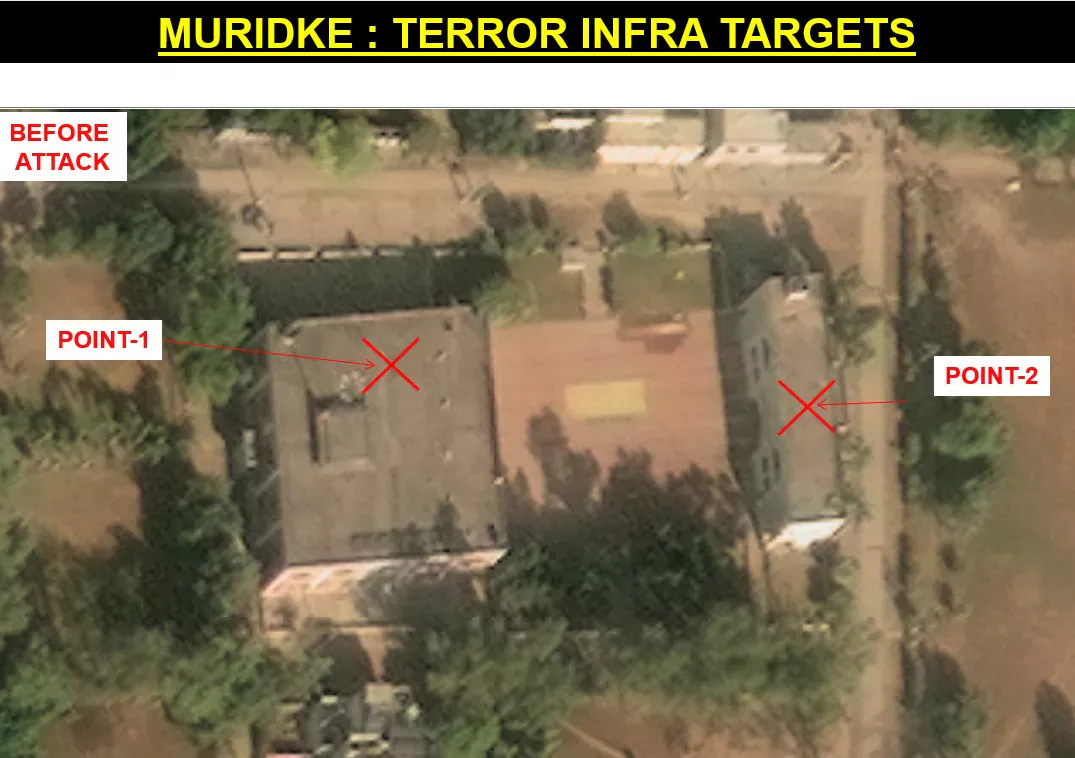
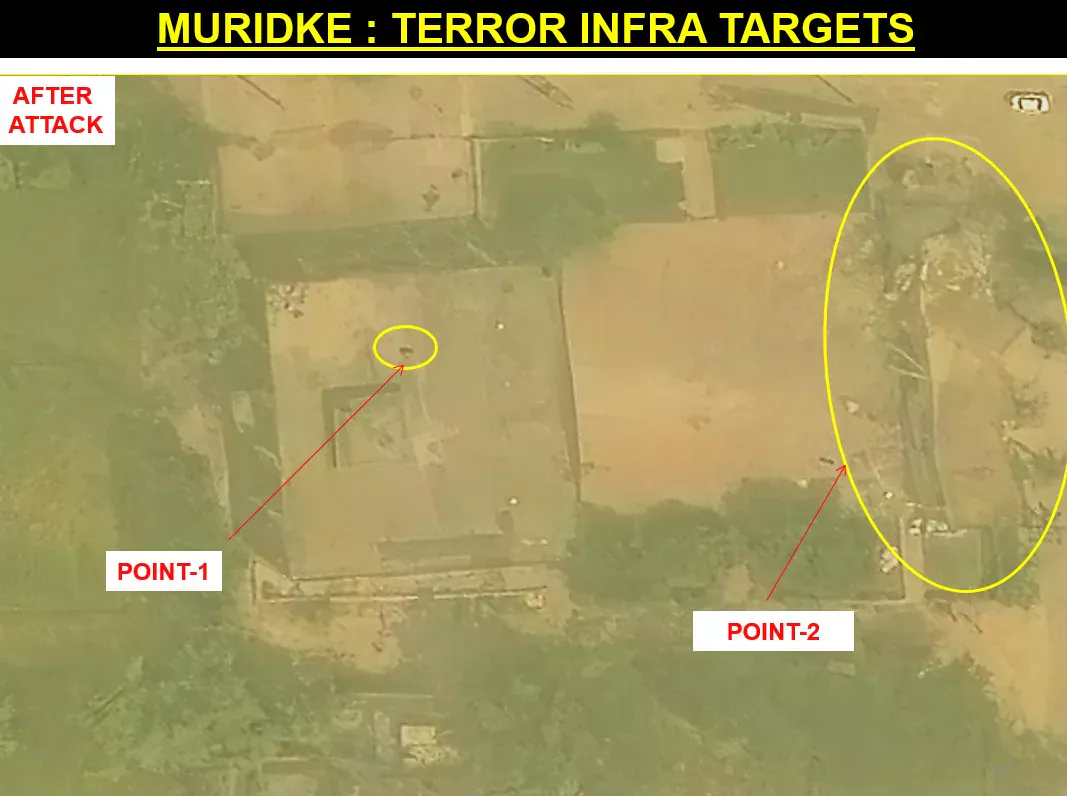
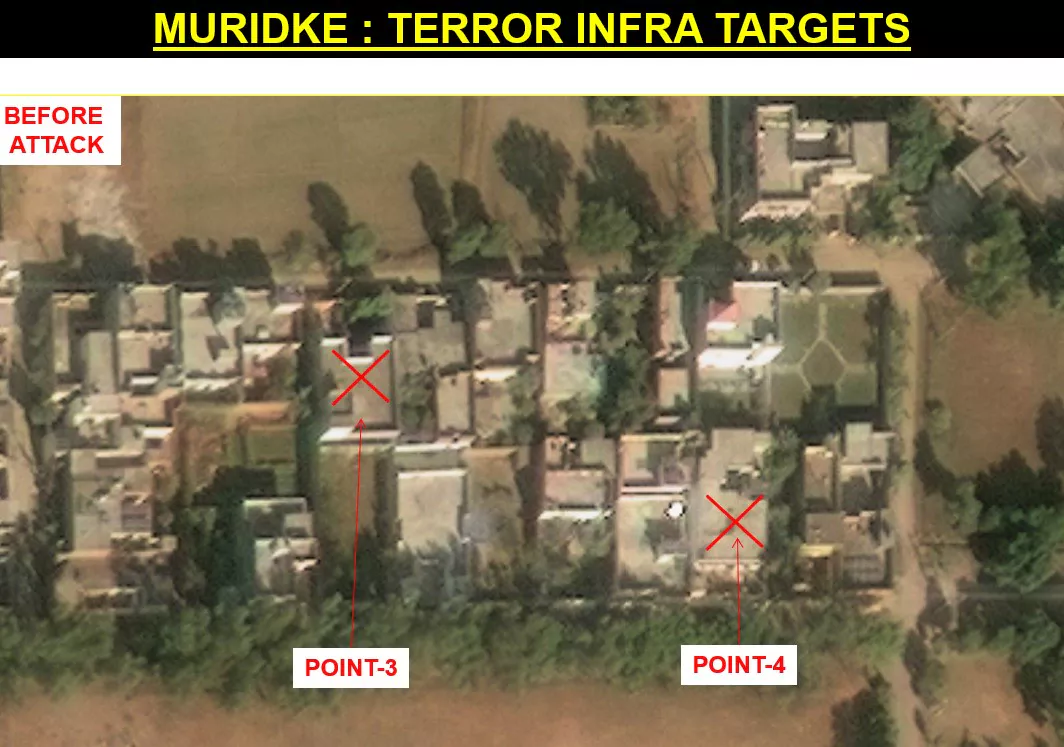
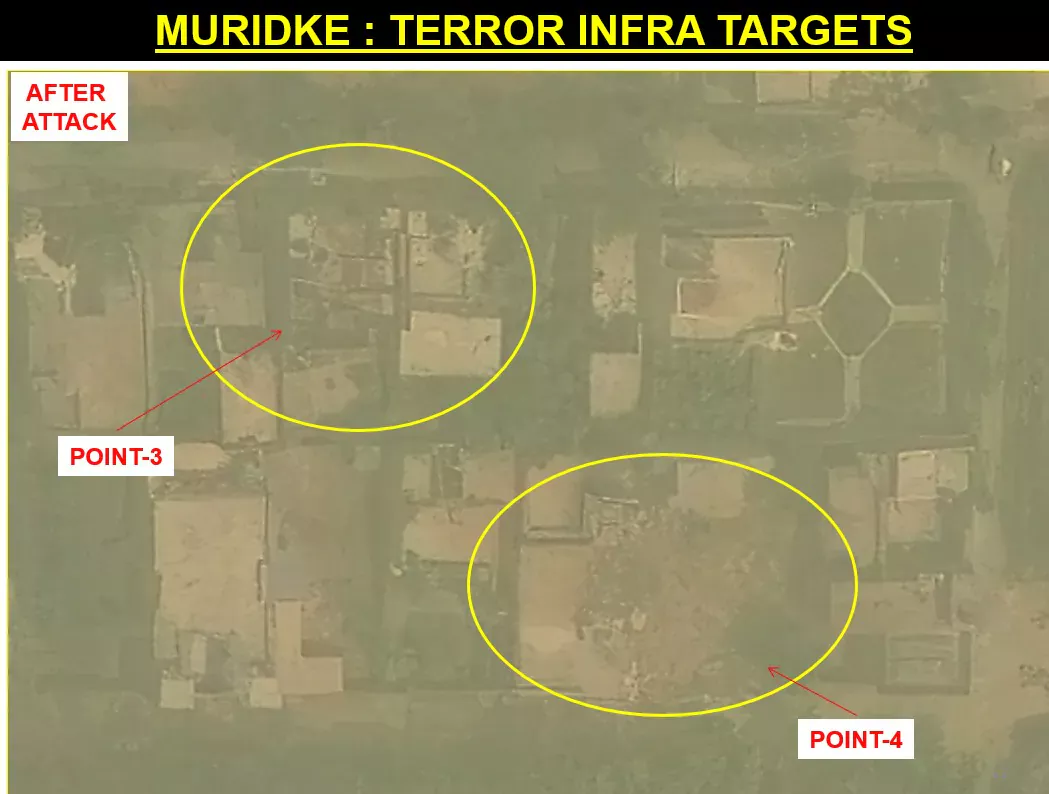
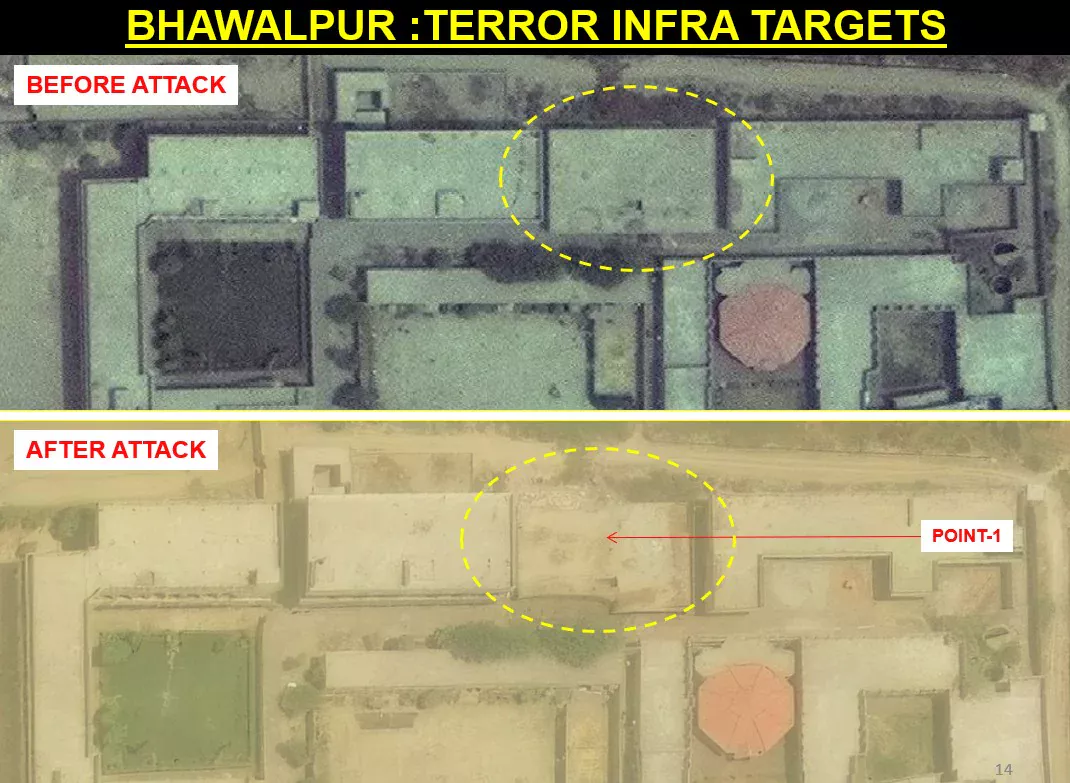
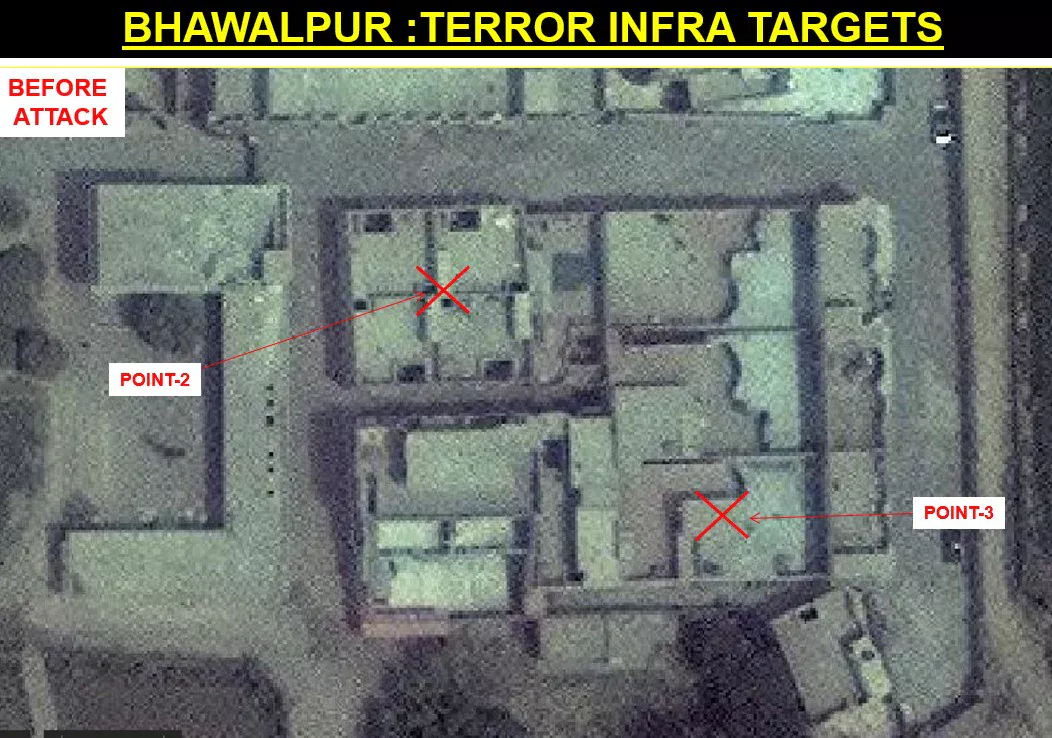
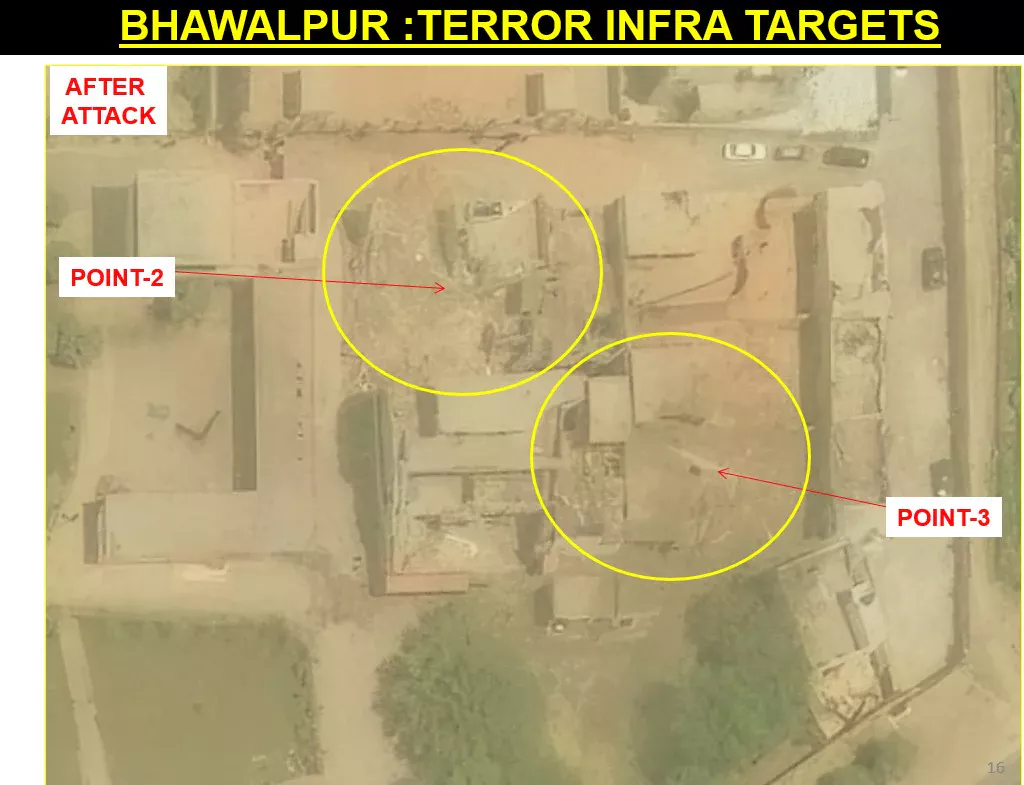
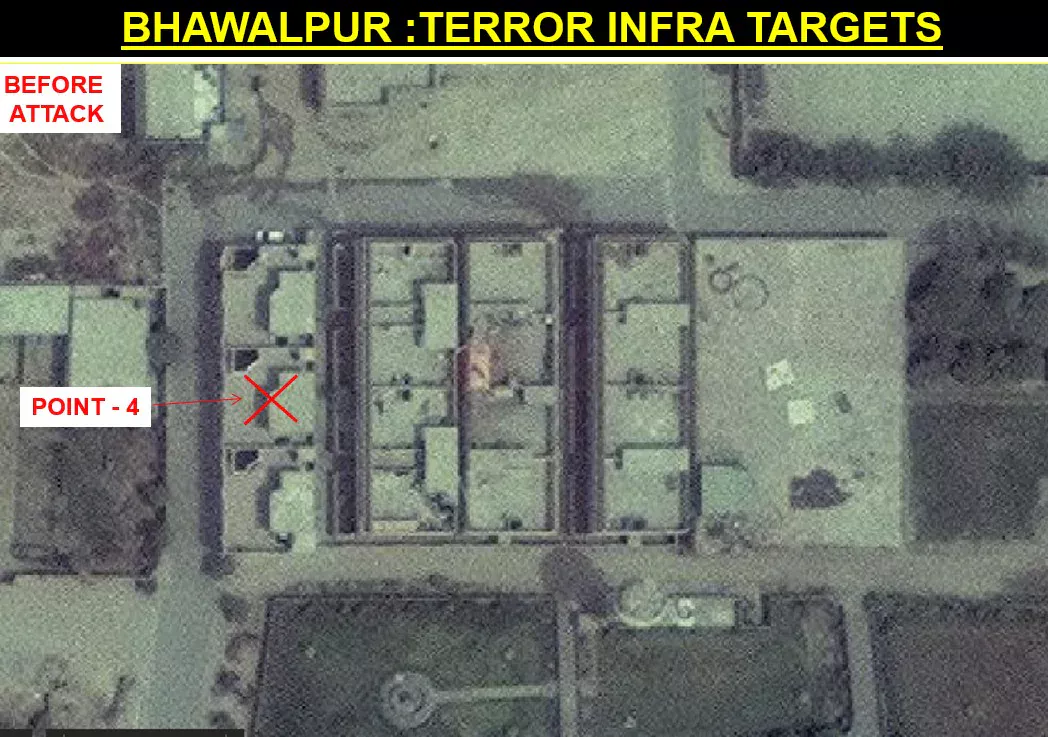
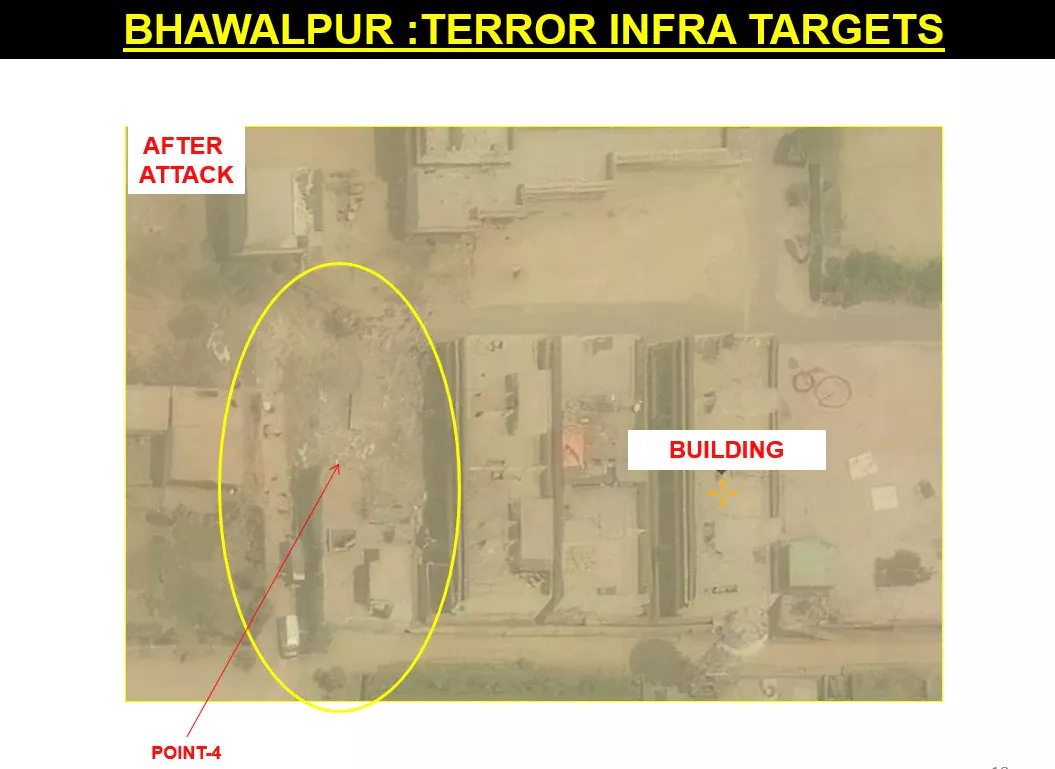
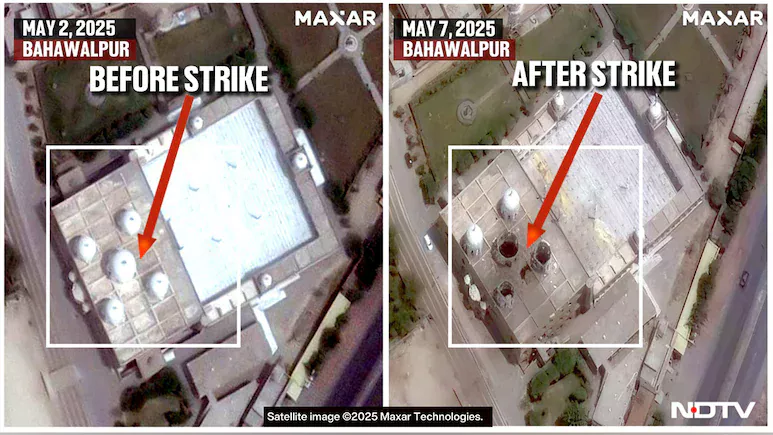
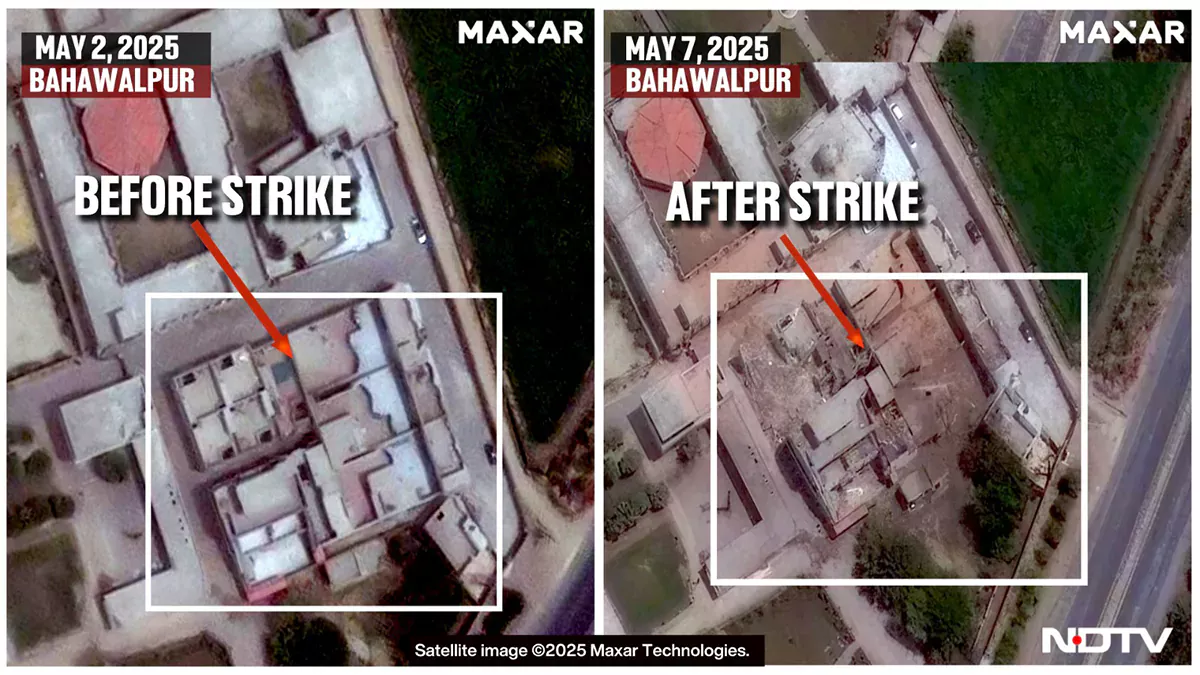
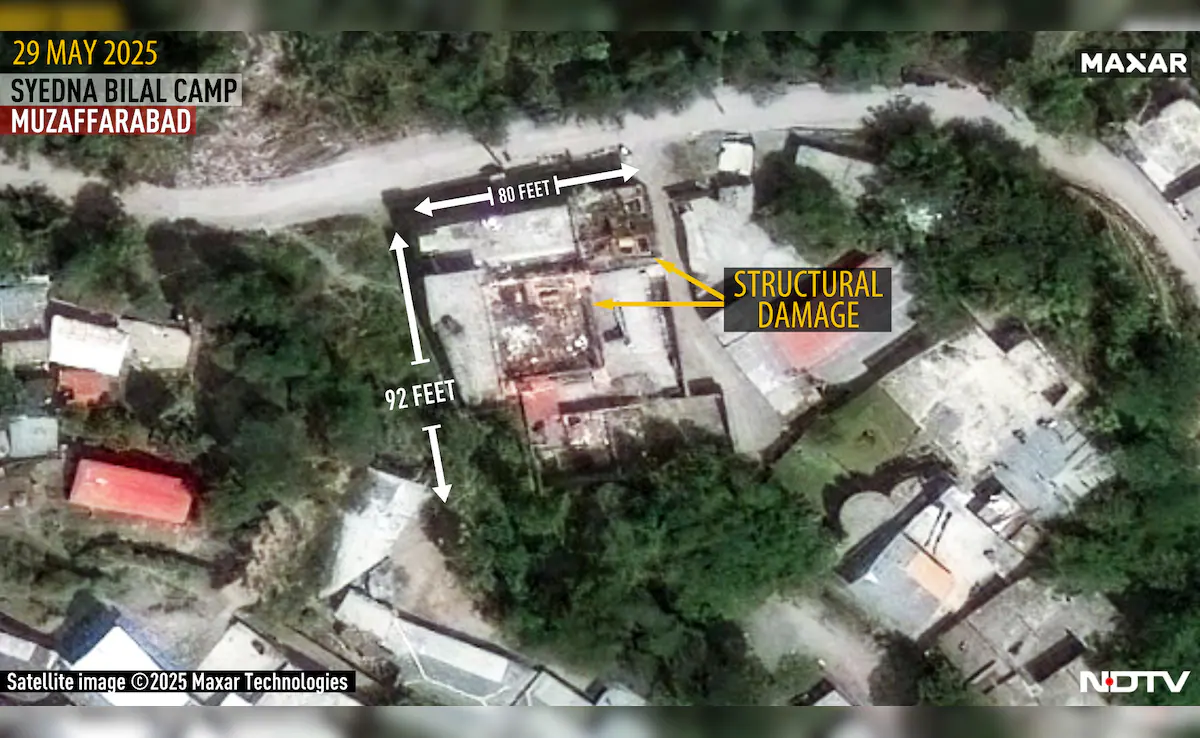
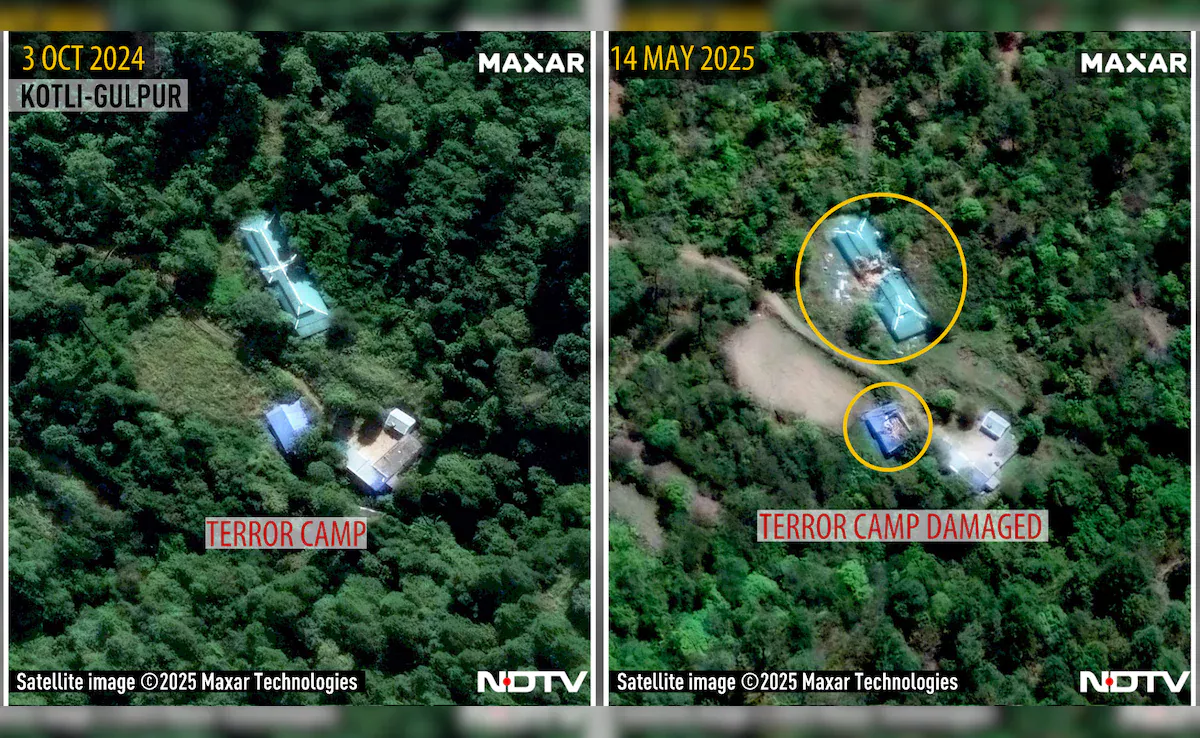
Additional before/after imagery for Tehra Kalan (Sialkot), Mehmoona Joya, Markaz Usman-o-Ali (Bhimber), and Shawai Nala camps will be added as high-resolution Maxar imagery becomes publicly available.
The choice to include targets in Muridke and Bahawalpur — deep inside Pakistani Punjab — was a deliberate strategic signal. These cities had been considered inviolable sanctuaries by Pakistan's terror-military complex for decades. By demonstrating that old geographic safe havens were no longer safe, India shattered a fundamental assumption underpinning Pakistan's proxy warfare doctrine.
India employed a mixed weapon package during these initial strikes: French-origin SCALP-EG cruise missiles and HAMMER precision-guided glide bombs deployed from Rafale fighters, combined with BrahMos supersonic cruise missiles. The use of BrahMos in particular marked a historic first — the first operational employment of this weapon system against Pakistan. Debris recovered in Pakistan confirmed the use of both SCALP-EG and BrahMos, validating India's multi-platform strike capability.
The Rafale-Spectra Shield: Electronic Warfare Dominance
Declassified details from the operation reveal the pivotal role played by the Rafale fighter's Spectra electronic warfare suite in protecting Indian strike formations. In one documented engagement over the Line of Control in the early hours of May 7, a pair of Pakistan Air Force F-16s achieved radar locks on an Indian Su-30MKI strike aircraft using AIM-120C AMRAAM beyond-visual-range missiles. The Su-30MKI, carrying Rampage stand-off munitions for a terror camp strike, was seconds from entering the missile's no-escape zone.
An escorting Rafale, tasked with providing air cover, deployed Spectra's full multi-spectral jamming capabilities — including digital radio frequency memory (DRFM) jammers, adaptive noise generation, false target injection, and range-gate pull-off techniques. Within 12 seconds, the F-16 radar locks fragmented completely, forcing the PAF pilots to abort their engagement and evade without firing. The strike package proceeded unmolested, delivering pinpoint hits that neutralized key command nodes.
This incident demonstrated a critical capability gap: India's electronic warfare technology could completely neutralize Pakistan Air Force BVR engagement capability, rendering their most advanced Western-supplied air-to-air missiles ineffective.
Phase II — Pakistan's Response and Indian Air Defense Supremacy: May 7–9
Pakistan's Drone Campaign
Following the May 7 strikes, Pakistan launched waves of drone attacks over the nights of May 7–8 and May 8–9, targeting locations across western and northern India. India's Director General of Air Operations characterized this as a "raid" designed to "saturate" Indian air defenses through "waves" of attacks using hundreds of drones.
However, according to official Indian assessments and corroborated by the absence of visible damage in satellite imagery, these attacks largely failed. India reported that the bulk of the drones were "poor quality, basic drones" — likely serving as flying chaff to clutter radars and probe air defense sites rather than deliver meaningful kinetic effects. Pakistan employed Turkish-origin Asisguard Songar drones and other unnamed armed UAVs, but the majority were intercepted or neutralized before reaching their targets.
The Akash Regiment's Epic Cross-Country Redeployment
One of the most remarkable operational feats of the conflict was the emergency redeployment of an entire Akash air defense regiment from eastern India to the northwestern frontier. Receiving urgent orders to reposition, the regiment — comprising launchers, multi-function phased-array radars, command vehicles, missiles, support equipment, and hundreds of personnel — executed a non-stop cross-country convoy covering thousands of kilometers.
The convoy rolled out under cover of darkness, maintaining strict radio silence and electronic discipline. Instead of following predictable highway routes, the regiment used a mix of national highways, secondary roads, and cross-country stretches. Drivers rotated in shifts, with only brief halts for refueling. Crucially, the Akash system's design allowed it to protect its own convoy while advancing — mobile radars monitored airspace throughout the entire journey.
The regiment arrived at its deployment sites with hours to spare before the Pakistani retaliatory strikes began, linking into the integrated Akashteer and IACCS air defense networks. This indigenous system provided a critical layer of defense that contributed directly to neutralizing incoming Pakistani drone and missile threats during the remaining days of the operation.
Indian Counter-Drone and Counter-Radar Operations
India responded to Pakistan's drone attacks with calibrated counterstrikes targeting Pakistani air defense radars using a combination of Israeli-origin Harpy and Harop drones, along with British-origin Banshee target drones deployed as decoys. On the morning of May 8, India successfully neutralized an air defense radar near Lahore. On May 8–9, India struck four additional air defense sites, destroying at least one more radar.
This systematic degradation of Pakistan's air defense network served a dual purpose: it imposed direct military costs while progressively expanding the corridors available for future Indian air operations. Each successful strike reduced Pakistan's ability to detect and engage Indian aircraft, creating a compounding strategic advantage that would prove decisive during the climactic strikes of May 9–10.
Phase III — The Decisive Strikes: May 9–10
The night of May 9–10 witnessed the climax of Operation Sindoor. Following what Indian Air Marshal Bharti described as "relentless attacks" by Pakistani drones, Indian leadership concluded it "was time to convey some message to our adversary" through a "strike where it would hurt." What followed was a "swift, coordinated, calibrated attack" targeting Pakistan's air bases, command centers, military infrastructure, and air defense systems — the most devastating aerial operation conducted against Pakistan since 1971.
Pakistani Airbase Strikes — Satellite Imagery and Coordinates
India struck at least eleven sites in the May 9–10 operation. The following table documents all confirmed Pakistani airbase and military targets with their satellite coordinates:
| # | Target | Coordinates | Assessed Damage |
|---|---|---|---|
| 1 | Nur Khan Airbase (PAF Chaklala, Rawalpindi) | 33°36'43"N 73°05'47"E | Severely damaged — blasts heard in Islamabad |
| 2 | Sargodha Airbase (PAF Mushaf) — Infrastructure | 32°54'39"N 72°46'37"E | Runway cratered — repair visible by May 11 |
| 3 | Sargodha Airbase — Hardened Aircraft Shelters | 32°54'02"N 72°46'24"E | Multiple shelters hit |
| 4 | Rafiqui Airbase — Runway and Aprons | 32°02'39"N 72°40'09"E | Targeted — PAF claims successful defense |
| 5 | Rafiqui Airbase — Support Infrastructure | 32°02'55"N 72°39'54"E | Strike attempted — results contested |
| 6 | Rahim Yar Khan Airbase (PAF Sheikh Zayed) | 28°23'15"N 70°16'47"E | Runway cratered — confirmed by satellite |
| 7 | Sukkur Airbase | 27°43'19"N 68°47'30"E | Large hangars struck — possible aircraft losses |
| 8 | Bholari Airbase | 25°14'35"N 68°02'11"E | Hangar housing Saab Erieye AEW&C severely damaged |
| 9 | Jacobabad Airbase | 28°17'04"N 68°27'01"E | Hangars struck |
| 10 | Shahbaz Airbase (support area) | 28°16'15"N 68°28'00"E | Infrastructure struck |
| 11 | Skardu Airbase | 35°20'12"N 75°32'12"E | Targeted |
| 12 | Murid — Command/Drone Operations | 32°54'36"N 72°46'26"E | Command infrastructure struck |
| 13 | Chunian — Drone Staging Area | 30°57'25"N 73°58'11"E | Radar/drone infrastructure hit |
Satellite Imagery — Pakistani Airbase Strike Sites (Before vs After)
Maxar/Planet Labs satellite imagery of confirmed airbase targets showing before-and-after strike damage. Source: NDTV / Reddit OSINT / Maxar Technologies.
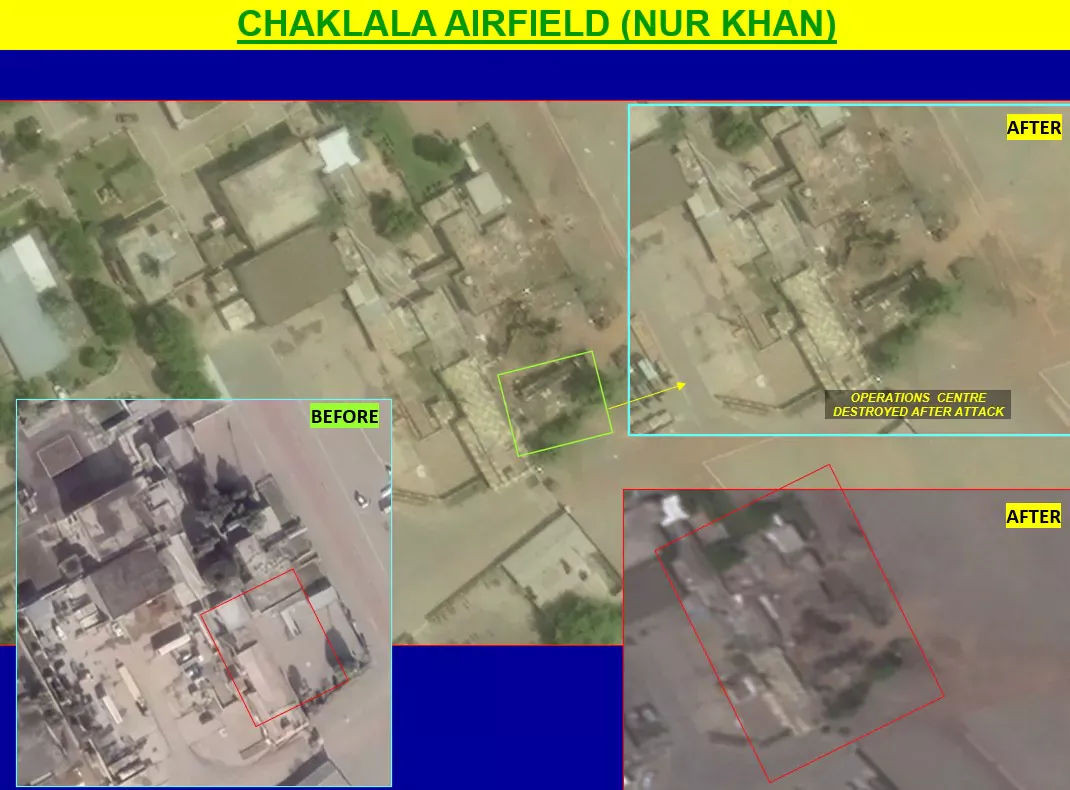
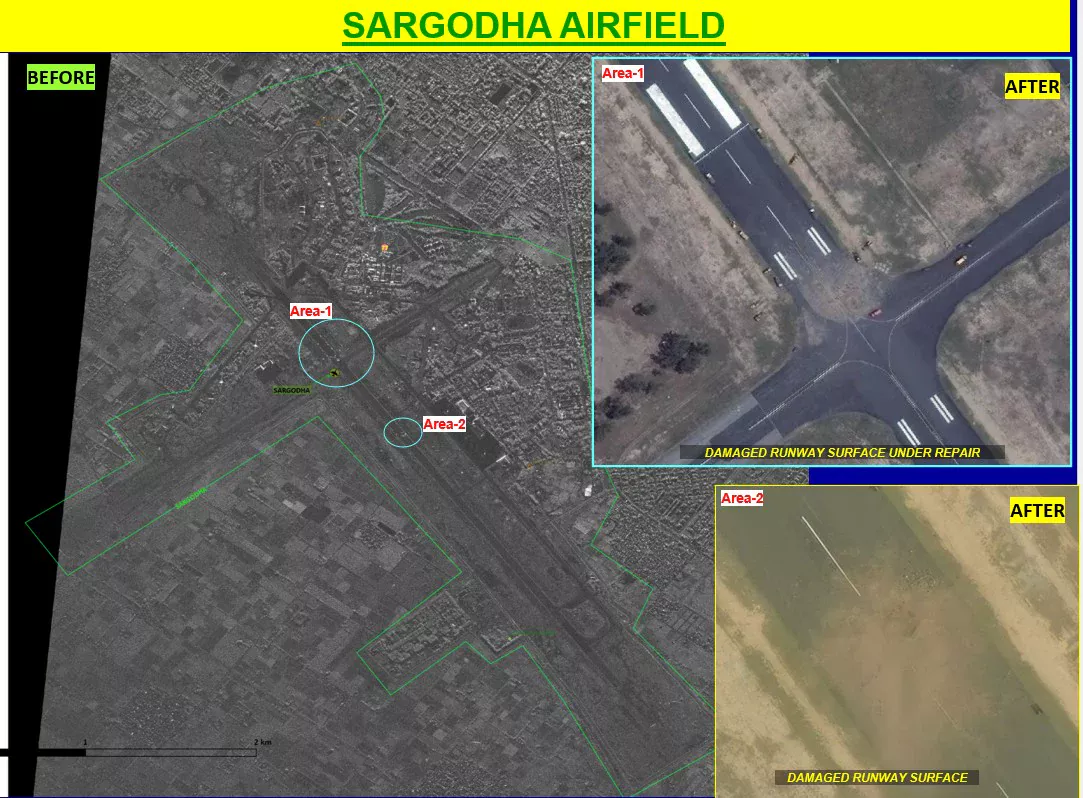
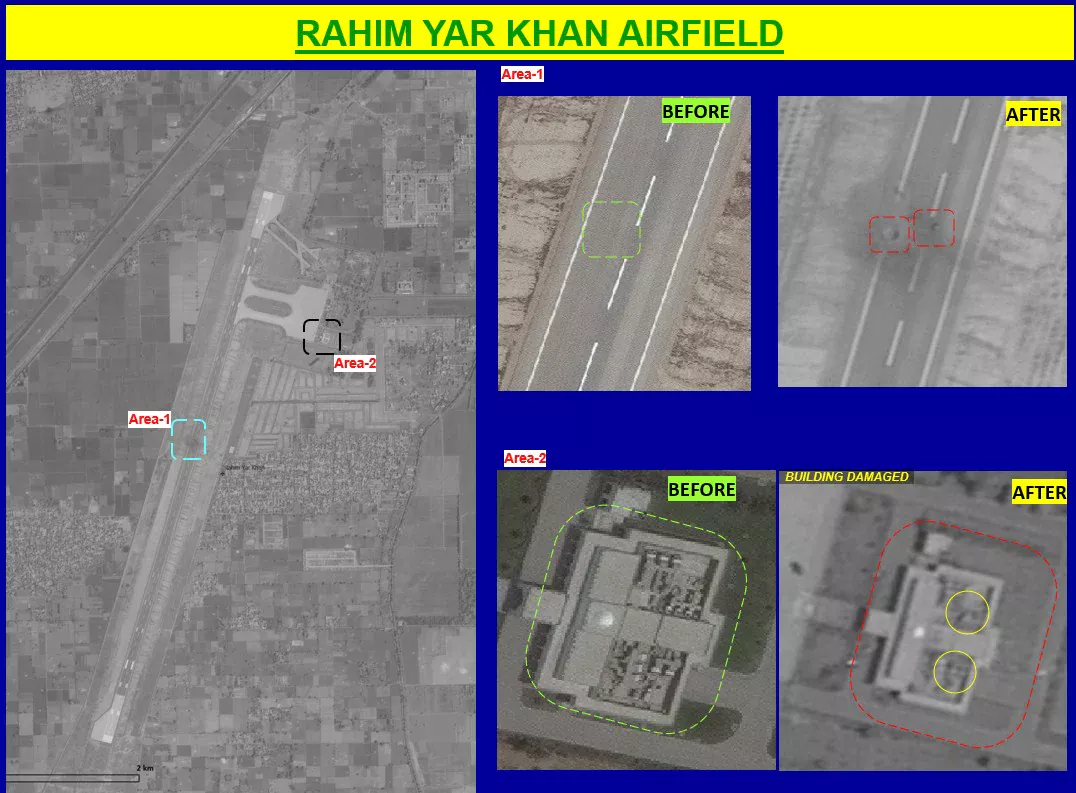
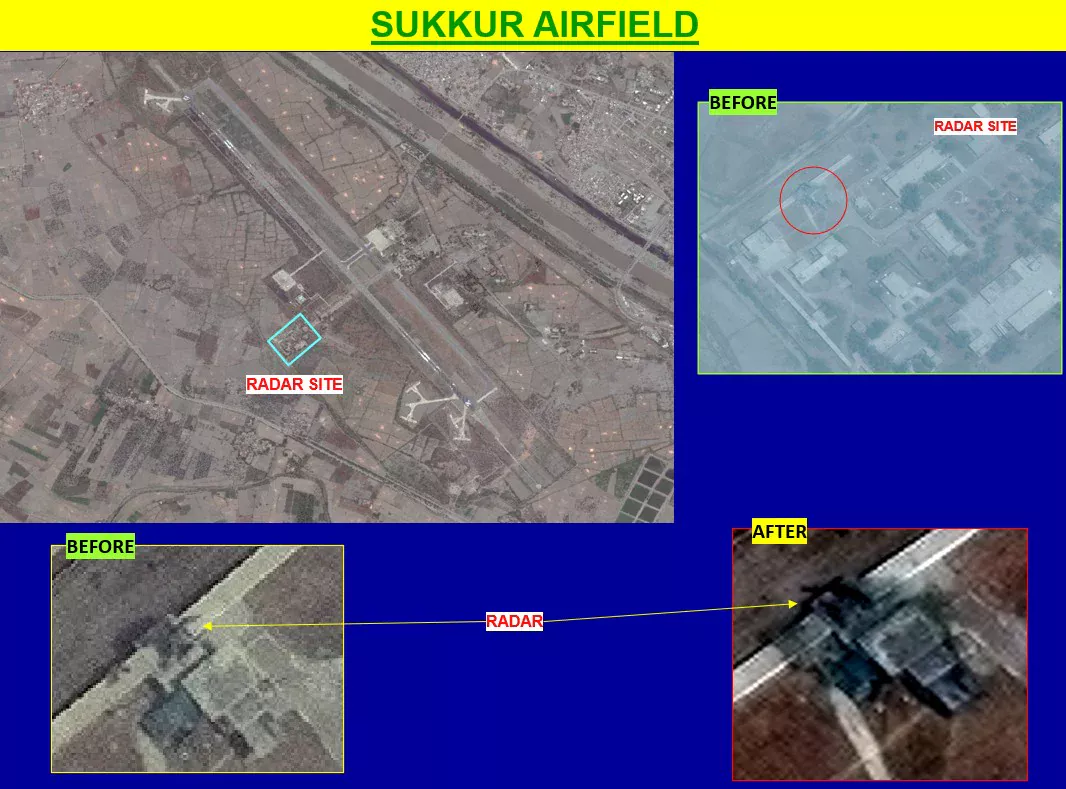
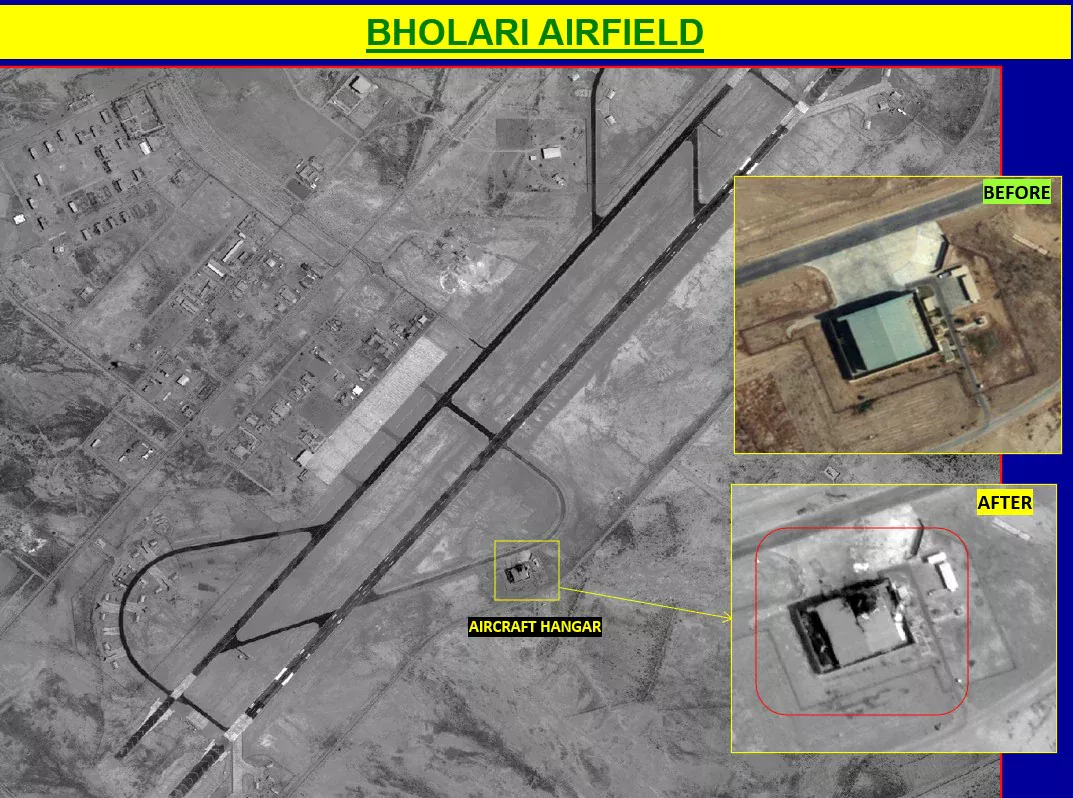
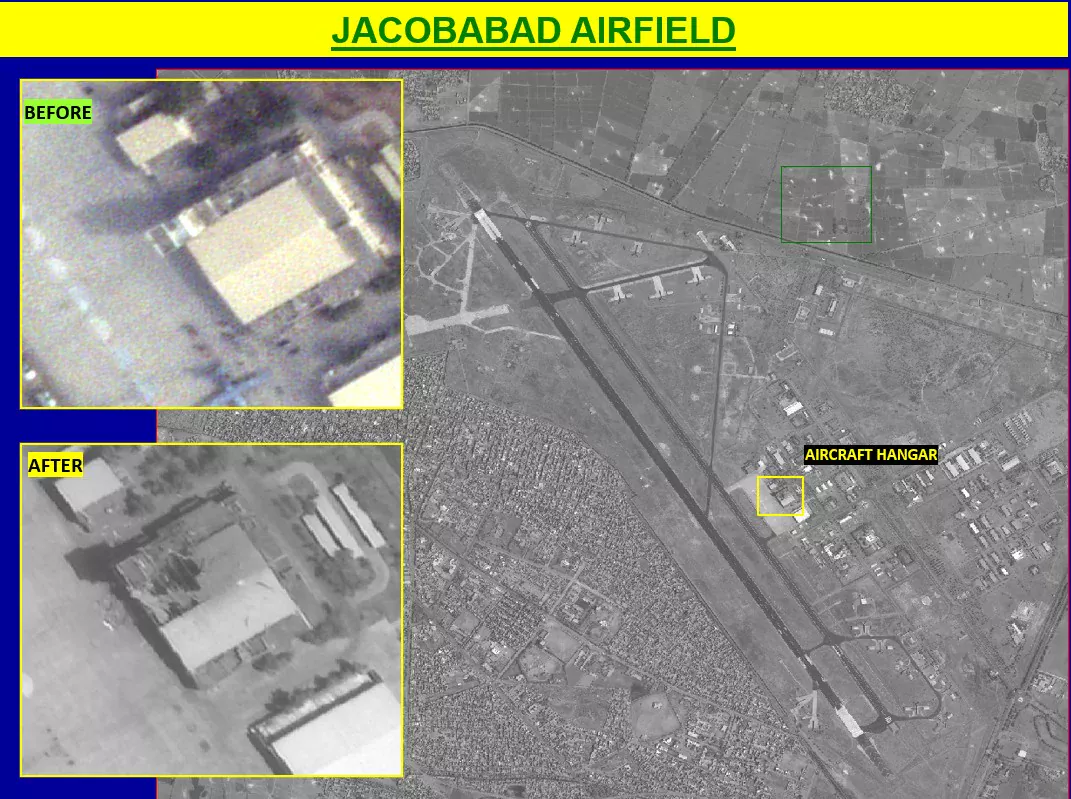
Additional imagery for Rafiqui, Skardu, and Murid airbases will be added as high-resolution commercial imagery is released.
Radar & Air Defense Strikes
In parallel with the airbase strikes, India systematically targeted Pakistani air defense radar installations and surface-to-air missile (SAM) sites to degrade the PAF's situational awareness. The following table documents all confirmed and assessed radar/SAM targets, drawing on geolocated OSINT data:
| # | Site | System | Coordinates | Status |
|---|---|---|---|---|
| 1 | Arifwala Radar Site | AN/TPS-77 MRR or YLC-8B | 30°07'36"N 72°59'26"E | Struck & destroyed |
| 2 | Chunian Radar Site | AN/TPS-77 MRR or YLC-8B | 30°57'25"N 73°58'12"E | Struck & destroyed |
| 3 | Pasrur Radar Site | AN/TPS-77 MRR | 32°14'19"N 74°41'21"E | Struck & destroyed |
| 4 | Walton Airport SAM Site | HQ-9P/BE | 31°31'N 74°24'E | C2 vehicle destroyed |
| 5 | Jacobabad 2nd Radar Site | Giraffe 40 (retracted) | 28°17'08"N 68°27'42"E | Struck & destroyed |
| 6 | Shahbaz Radar Site | AN/TPS-77 (radome) | 28°16'15"N 68°28'00"E | Struck — near PAF Shahbaz |
| 7 | Bholari Radar Site | Likely AN/TPS-77 | 25°14'49"N 68°01'02"E | Struck — near PAF Bholari |
| 8 | Malir Cantt. SAM Site | HQ-9BE | 24°56'11"N 67°12'37"E | Possibly struck (May 9–10) |
| 9 | Chor Radar Site | AN/TPS-77 (under construction) | 25°31'32"N 69°46'27"E | Possibly targeted — 58 km from IB |
| 10 | Sukkur Radar Site | AN/TPS-43G/J | 27°43'00"N 68°47'20"E | Near struck PAF Sukkur |
| 11 | Sargodha Radar Site | AN/TPS-77 | 32°03'20"N 72°40'05"E | Near struck PAF Mushaf |
| 12 | PAF Base Murid SAM Site | Likely FM-90 | 32°55'09"N 72°45'54"E | Underground munitions struck |
| 13 | PAF Base Nur Khan SAM Site | HQ-9BE | 33°37'16"N 73°05'03"E | Ineffective against Indian strikes |
Comprehensive Pakistani Radar & SAM Network (Geolocated)
The following additional radar and SAM sites were geolocated from open-source intelligence but are not confirmed as struck during Operation Sindoor. They provide context for the overall Pakistani integrated air defense network that India successfully penetrated.
| Site | System | Coordinates |
|---|---|---|
| Sakesar Radar Site (410th Sqn) | YLC-2A (radome) | 32°32'33"N 71°56'07"E |
| Gwadar Radar Site | YLC-18 / TPS-43G/J | 25°06'08"N 62°20'14"E |
| Akram Radar Site | YLC-18 / TPS-43G/J | 25°06'09"N 62°22'57"E |
| Ormara Radar Site | MPDR30/1 | 25°11'20"N 64°41'03"E |
| Masroor Radar Site | AN/TPS-77 (radome) | 24°54'15"N 66°55'50"E |
| Badin Radar Site (39 km from IB) | YLC-2A | 24°39'19"N 68°51'47"E |
| Mangla Radar Site (on IB) | AN/TPS-77 or YLC-2A (radome) | 33°09'29"N 73°38'16"E |
| Faisalabad Radar Site (Risalewala) | AN/TPS-77 MRR | 31°22'22"N 72°59'27"E |
Satellite Imagery — Radar & Air Defense Strike Sites (Before vs After)
Satellite imagery showing before-and-after damage at confirmed radar and air defense targets destroyed during Indian SEAD (Suppression of Enemy Air Defenses) operations.
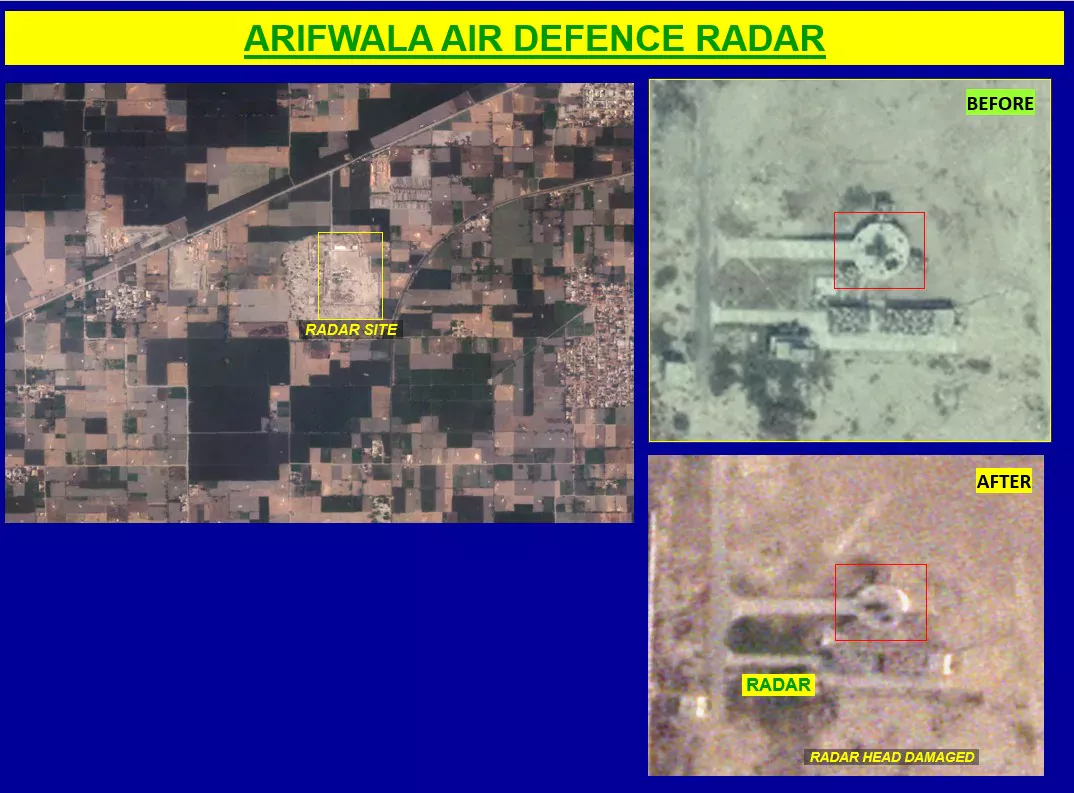
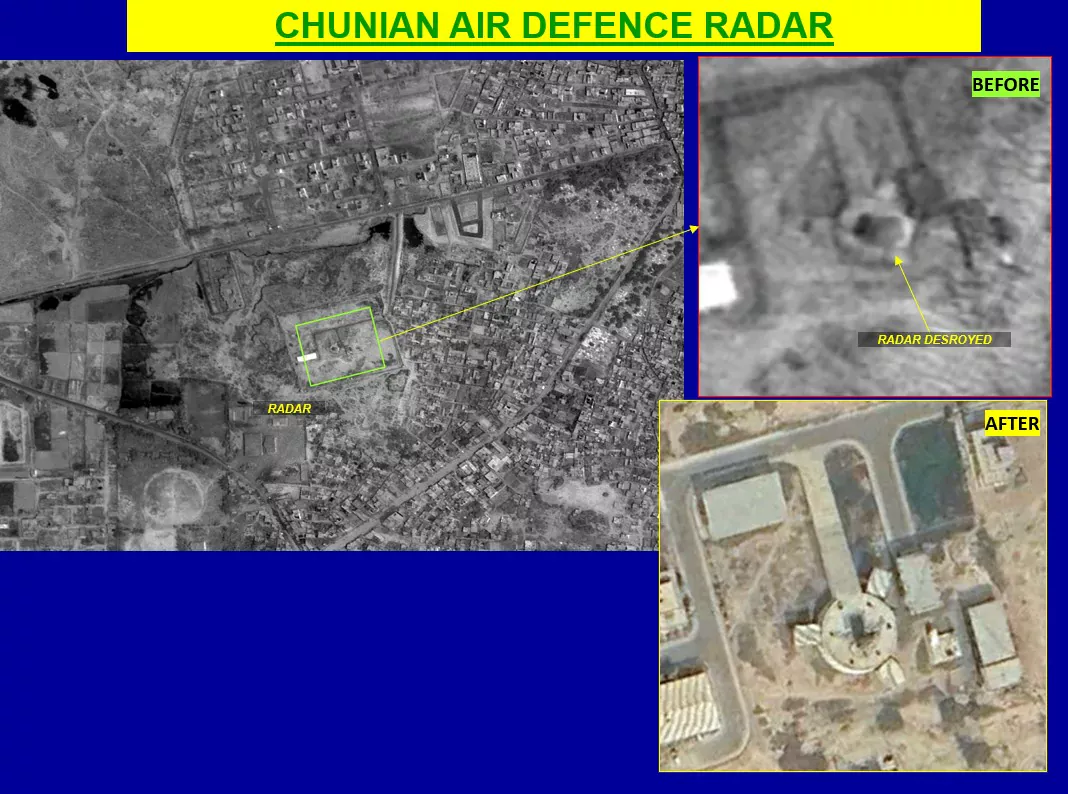
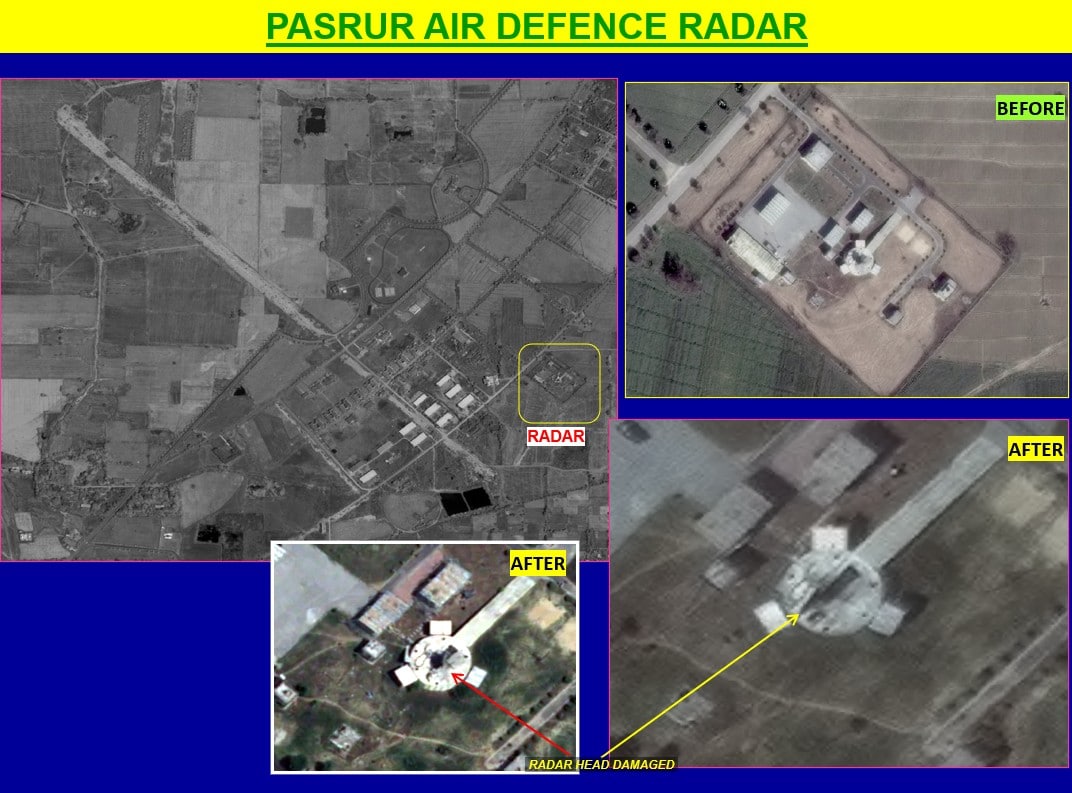
Additional imagery for Walton Airport HQ-9, Jacobabad/Shahbaz radar, and Bholari radar sites will be added as high-resolution imagery becomes publicly available.
The systematic destruction of these radar stations created critical blind spots in Pakistan's integrated air defense network, allowing subsequent Indian strike packages to operate with significantly reduced risk. This approach — degrading air defense capability before escalating offensive operations — reflects sophisticated campaign planning and demonstrates doctrinal maturity within the Indian armed forces.
The Nur Khan Strike: "Mind You — Chaklala Is Islamabad"
The most politically significant strike of the campaign was the attack on Nur Khan airbase (also referred to as PAF Chaklala), located at 33°36'43"N 73°05'47"E within the Chaklala military cantonment near Rawalpindi. The blasts were powerful enough to wake residents in Pakistan's capital, Islamabad. India's Air Marshal Bharti emphasized the significance during his post-conflict briefing, pausing after mentioning the target to note: "Mind you: Chaklala is Islamabad."
This was a deliberate strategic signal showcasing India's ability to project power into Pakistan's political and military heartland with precision. The strike demonstrated that India possessed both the capability and the will to reach any point within Pakistan's territory — a transformative shift from the limited cross-border operations of 2019.
Bholari: The Erieye Kill
According to the CHPM assessment, the strike at Bholari Airbase severely damaged a hangar housing one or more Saab 2000 Erieye airborne early warning and control (AEW&C) aircraft. This was among the most consequential strikes of the operation — the Erieye platform is the backbone of PAF's airborne surveillance and battle management capability. Its degradation directly impacted Pakistan's ability to coordinate air defense and fighter operations, creating a cascading operational deficit that compounded every other damage sustained.
Weapons Mix and Tactical Innovation
The May 9–10 strikes employed a complex multi-domain attack package that showcased the integrated sophistication of India's strike architecture:
- BrahMos supersonic cruise missiles — Mach 2.8 speed with precision terminal guidance, highly effective against hardened and buried targets
- SCALP-EG cruise missiles — Stealthy, terrain-hugging French-origin missiles with 250+ km range, deployed by Rafale fighters
- Israeli Crystal Maze and Rampage missiles — Solid-propellant precision weapons for time-critical targets
- Harop loitering munitions — Anti-radiation capability for suppressing air defense emissions
- Harpy anti-radiation drones — Autonomous seekers for destroying active radar emitters
- Banshee target drones — Deployed as decoys to saturate Pakistani radar screens and draw fire
The combination of decoy drones drawing Pakistani air defense fire, anti-radiation munitions targeting emitting radars, and precision cruise missiles striking hardened targets demonstrated the kind of integrated, multi-layered attack doctrine that only the most advanced militaries can execute. Prior Indian drone attacks on May 8–9 had already weakened Pakistani defenses both through direct damage and by forcing defenders to reduce radar emissions to avoid anti-radiation munitions — a compounding advantage that India exploited decisively.
The S-400 Shield: India's Apex Air Defense
India's Russian-made S-400 Triumf air defense system served as the apex layer of India's defensive architecture during Operation Sindoor. European defense analyst John Helmer assessed that the S-400 provided "a decisive umbrella" during the operation, enabling India to monitor PAF movements deep inside Pakistani airspace and creating a deterrent effect that limited Pakistan's escalation options.
The S-400's long-range detection and engagement capability — tracking multiple targets simultaneously at extended ranges — gave India unprecedented situational awareness and control over the aerial battlespace. Debris recovered in both India and Pakistan appears consistent with S-400 interceptor use, indicating the system was operationally employed during the conflict, including attempted intercepts within Pakistani airspace.
Pakistan invested significant effort in attempting to neutralize the S-400. Official Pakistani sources claimed their air force located, targeted, and destroyed an S-400 element at Adampur, Indian Punjab. However, Indian sources reported that an air-launched Chinese-origin cruise missile was directed at the S-400 but the attack failed. Despite Pakistani military briefers stating there were "loads of pictures" of damaged Indian targets, no evidence of a disabled S-400 component has emerged in the public domain. This claim remains entirely unsubstantiated.
The successful operational deployment of the S-400, combined with the indigenous Akash system and anti-drone capabilities, created a layered defense network that intercepted the majority of Pakistani retaliatory strikes. The post-conflict behavioral shift observed in the PAF — repositioning high-value assets deeper inland, prioritizing counter-S-400 strategies — confirms the system's strategic impact.
BrahMos in Combat: Supersonic Precision
Operation Sindoor marked the first confirmed combat deployment of the BrahMos supersonic cruise missile against Pakistan. Co-developed with Russia, the BrahMos travels at approximately Mach 2.8 — nearly three times the speed of sound — giving defenders minimal reaction time. Its precision terminal guidance enabled India to strike specific structures within military installations while minimizing collateral damage.
European analyst John Helmer noted that BrahMos served as "a significant offensive lever" during the operation, conveying India's ability to conduct "rapid, high-accuracy strikes against high-value targets inside Pakistan with minimal warning." The synergy between S-400 securing the skies and BrahMos threatening critical infrastructure established what Helmer described as "dual-domain dominance" that fundamentally altered the strategic calculus on the Western front.
Pakistan's Retaliatory Efforts and Their Limited Effect
Pakistan's retaliatory campaign relied heavily on drone swarms and short-range ballistic missiles, including the Fatah-I and Fatah-II systems. Pakistan deployed Turkish-origin Yiha-III kamikaze drones alongside the smaller Asisguard Songar platforms. However, the overall impact was severely limited.
Reported Incidents at Indian Installations
Indian officials acknowledged limited damage from drone attacks at four locations: Udhampur, Pathankot, Adampur, and Bhuj. Additionally, India acknowledged "several high-speed missile attacks" at air bases in Punjab. The following incidents were reported, though most involved minimal structural impact:
| Location | Coordinates | Assessment |
|---|---|---|
| Armored Corps area, Jalandhar Cantonment, Punjab | 31°17'35"N 75°38'21"E | Minor structural impact — non-operational area |
| Structure at Jalandhar Cantonment perimeter | 31.3008128°N 75.6081479°E | Peripheral damage — operations unaffected |
| Hangar vicinity, Amritsar Airbase, Punjab | 31.6998965°N 74.7895900°E | Superficial damage to secondary structure |
| Support facility near Amritsar Airbase | 31.6989272°N 74.7983357°E | Minor debris impact — rapidly repaired |
| Amritsar Airbase perimeter area | 31.6951055°N 74.7929441°E | Light impact — no operational disruption |
| Hamidpura area, Punjab | 31°38'46.0"N 74°46'07.0"E | Minor kinetic debris — no strategic impact |
| Amritsar Cantonment vicinity, Punjab | 31.6395682°N 74.8420644°E | Peripheral structure affected — non-critical |
| Shelter area near Amritsar runway | 31°42'36"N 74°47'56"E | Minor surface damage — operations continued |
| Runway 16/34 support area, Amritsar Airbase | 31°42'41"N 74°48'03"E | Cosmetic damage only — rapidly restored |
The critical takeaway: despite Pakistan's claims of "major damages" at 15 Indian airbases, there is virtually no visual evidence from social media photos or commercial satellite imagery of meaningful damage at Indian facilities. Indian missile and standoff air strikes, in contrast, created numerous visible signatures validated by Indian government-released satellite imagery, commercial satellite imagery, and social-media documentation. As one independent assessment noted: "Indian strikes created damage at a scale difficult for the Government of Pakistan to suppress" — while any Pakistani-inflicted damage "was not at a scale that was difficult for the Government of India to suppress."
The asymmetry is stark. Most of the largest Pakistani weapons for which debris was identified on Indian soil — specifically the Turkish-origin Yiha-III drones — carry warheads roughly one-tenth the size of the Indian BrahMos or SCALP-EG missiles. The Fatah-I and Fatah-II short-range ballistic missiles carry larger warheads comparable to BrahMos or SCALP-EG, but the absence of visible damage from satellite imagery suggests that many or perhaps all Pakistani ballistic missiles were intercepted or missed their targets. Some Indian officials have claimed that all Pakistani missiles were intercepted prior to reaching their targets.
Air Superiority: The CHPM Independent Assessment
The Centre for Military History and Perspective Studies (CHPM) — a Swiss military think tank whose journals and studies circulate widely among European military headquarters and planning offices — released a comprehensive assessment authored by military historian Adrien Fontanellaz and vetted by experts including a retired Swiss Air Force major general.
CHPM's key findings paint a decisive picture:
- India achieved air superiority over large swaths of Pakistani airspace, enabling sustained offensive operations against key military targets
- Pakistan suffered heavier verified losses — at least one F-16 destroyed or damaged, one Mirage III/V shot down, and one C-130 transport aircraft destroyed or severely damaged
- Indian losses were lower — estimated at three aircraft total (one Rafale, one Mirage 2000I, one MiG-29UPG), none of which altered the operational balance
- The Bholari strike degraded Pakistan's AEW&C capability by severely damaging hangars housing Erieye aircraft
- India's escalation control steadily shifted the balance without crossing nuclear red lines, ultimately forcing Pakistan to seek a ceasefire
The CHPM findings are credible precisely because CHPM has no strategic interest in South Asia — it is an independent European institution with no ties to either country. The reaction from Pakistan was revealing: official think tank circles produced multiple rebuttal videos, including one featuring an Air Marshal, but these largely relied on deflection and familiar geopolitical talking points rather than engaging with the report's specific claims about aircraft losses, radar degradation, and operational timelines.
Post-Conflict Doctrinal Impact on Pakistan
The behavioral shifts observed in the Pakistan Air Force since Operation Sindoor confirm the magnitude of the strategic impact. By 2026, discernible changes include:
- Rear-tier basing: High-value airborne assets — particularly AEW&C and aerial refueling platforms — have been repositioned to bases deeper inland such as Pasni and Jacobabad, outside the theoretical engagement envelope of the S-400
- Electronic warfare focus: Pakistan is exploring stand-off jamming platforms, including Turkish-origin systems, aimed at degrading S-400 radar performance
- Drone swarm investment: A shift toward unmanned, attritable systems designed to saturate Indian air defenses and exhaust interceptor inventories
- Hypersonic weapons interest: Emphasis on high-speed strike options like the CM-400AKG to overwhelm air defense processing timelines
- Distributed sensing: Efforts to decouple airborne surveillance from proximity by extending data-links to rear-positioned AEW&C platforms
Each of these adaptations carries significant limitations. Stealth programs are generational, electronic warfare requires technological parity, drone swarms can be countered by layered defenses and EW, and hypersonic weapons remain expensive and limited in quantity. The fundamental reality that modern air defense systems like the S-400 are designed as part of integrated networks — combining radars, interceptors, passive sensors, and electronic warfare layers — means that defeating them requires synchronized multi-domain operations far beyond Pakistan's current capabilities.
Strategic Assessment and Conclusion
Operation Sindoor demonstrated that India has achieved a qualitative military advantage over Pakistan that Pakistan cannot easily close. The operation established several precedents:
- Strategic reach: India demonstrated the ability to deliver precise standoff attacks across the entire geographic depth of Pakistan, from PoK to Punjab to Sindh, on each day of the conflict
- Escalation dominance: India's systematic approach — striking terrorist infrastructure first, then degrading air defenses, then hitting military bases — demonstrated sophisticated campaign planning and escalation control
- Integrated multi-domain warfare: The combination of electronic warfare (Spectra), long-range air defense (S-400), precision deep strike (BrahMos, SCALP-EG), and indigenous systems (Akash) operated as a coherent, synergistic whole
- Coercive signaling: The Nur Khan/Chaklala strike — in the heart of Pakistan's political and military establishment — sent an unmistakable message about India's capability and willingness to escalate
- Defensive resilience: India's layered air and missile defense system, combining the S-400, Akash, and anti-drone systems, largely defeated Pakistan's retaliatory drone and missile waves with minimal damage to Indian assets
The Four-Day Conflict was ultimately resolved through a US-brokered ceasefire on May 10, with Secretary of State Marco Rubio playing a central role in final-hour diplomacy. But the military balance was already clear: India had imposed costs that Pakistan could not sustain and could not reciprocate. Pakistan's persistent DGMO calls seeking a ceasefire, the brief and revealing announcement (then cancellation) of a National Command Authority meeting, and the absence of any meaningful damage on Indian soil all testify to the decisive nature of India's operation.
Operation Sindoor will serve as the baseline for the next India-Pakistan crisis. The lesson for Pakistan is clear: the era of proxy warfare with impunity is over. India now possesses both the defensive depth and the offensive reach to dominate a conflict environment — and the political will to employ those capabilities decisively when provoked.
Bibliography
Clary, Christopher. "Four Days in May: The India-Pakistan Crisis of 2025." Working Paper. The Stimson Center, May 28, 2025. https://www.stimson.org/2025/four-days-in-may-the-india-pakistan-crisis-of-2025/
Fontanellaz, Adrien. "Operation Sindoor: The India-Pakistan Air War (7–10 May 2025)." Exploratory Note. Centre for Military History and Perspective Studies (CHPM), Switzerland, January 2026.
Helmer, John. Analysis on S-400 and BrahMos operational effectiveness during Operation Sindoor. December 2025.
Indian Air Force. Official post-conflict briefing by Air Marshal Bharti, Director-General of Air Operations. May 11, 2025.
Government of India. Official daily briefings and satellite imagery releases, May 7–10, 2025.
Reuters. Reporting on aircraft downings, ceasefire negotiations, and J-10/PL-15 involvement. May 7–10, 2025.
The Washington Post. Visual investigation of crash sites in India. May 2025.
CNN. Reporting on US nuclear concerns and alarming intelligence during the crisis. May 9, 2025.
The New York Times. Reporting on US diplomatic involvement and crisis escalation. May 2025.
Lewis, Jeffrey (Middlebury Institute of International Studies). Assessment of damage to Pakistani air bases from satellite imagery. May 2025.
Disclosure: This analysis was compiled by Conflict.asia Management using open-source intelligence and has been refined with AI assistance for structural consistency, analytical depth, and editorial clarity. All coordinates reference publicly available satellite imagery platforms. Where claims remain contested between the two sides, we have noted the evidentiary basis. Readers are encouraged to verify coordinates using Google Earth or similar platforms.
Discussion
Reader signal check
1 approved comment
Ananya Thackeray
2 days ago
Very informative but also this is very clearly biased. A little less bias would be nicer!
Sign in to comment. Every submission passes through moderation before it appears publicly.